
Howell Quality Roofing has been replacing roofs in Howell, NJ for more than 20 years, serving surrounding cities including Ramtown, Freehold Township, Wall, West Freehold and Vista Center. We handle complete tear-offs on colonials, split-levels, ranches, townhouses and small commercial buildings, from the first sheet of plywood against the siding to the last magnet sweep of the lawn.
A roof replacement is a large purchase, and the way it is priced should make sense to the person paying for it. Our written scopes break the job into tear-off, decking, underlayment, flashing, ventilation and gutters, each on its own line. You can see what is included, compare it against any other bid item by item, and know exactly what could change once the old roof is off.
We also only recommend replacement when the roof actually needs it. If a repair would buy you several good years, we tell you that first. When a roof is brittle on every slope, leaking in several places or already carrying a second layer, replacement is usually the better use of your money, and we show you the photos that support that call.
How a Full Tear-Off Replacement Works
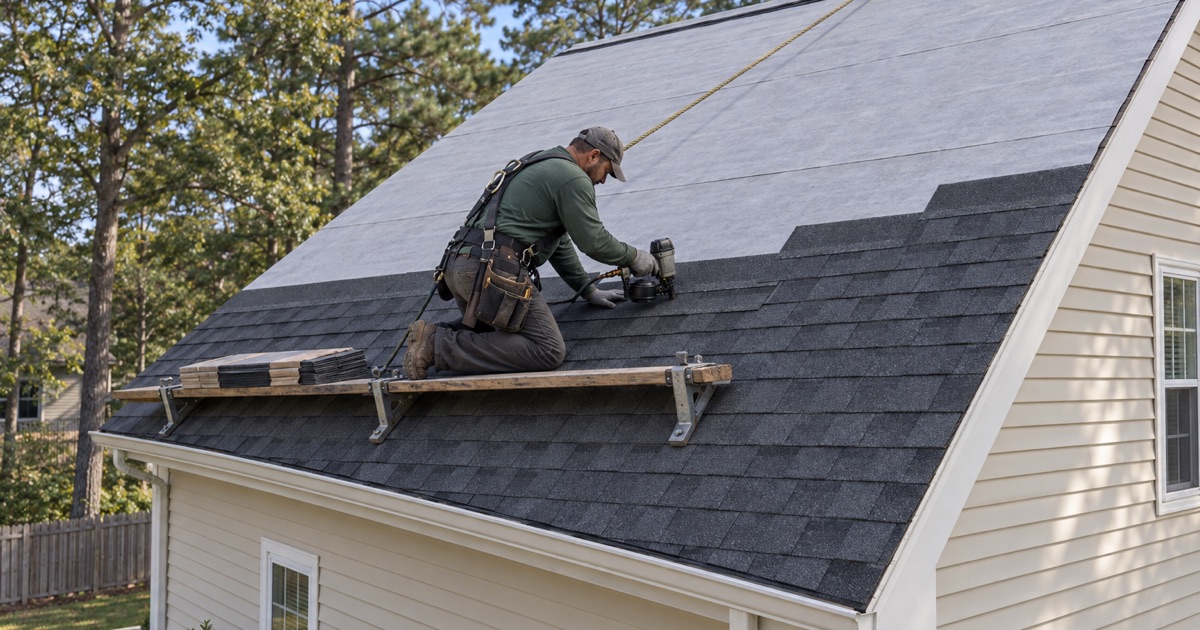
Protecting the House and Yard
Before any shingles come off, we position the dumpster, lay tarps over planting beds and the lawn near the walls, and lean plywood against windows and siding where debris will fall. Gutters are checked so they are not crushed by falling bundles. These steps take time at the start of the day, and they are why the yard looks the same when we leave as it did when we arrived.
Stripping to the Deck
We remove every layer down to the plywood or boards, including old felt, ice barrier, drip edge and flashing. Stripping to the deck lets us check every sheet for rot, delamination and loose nailing, and it is the only way to be sure the new roof is fastened to something solid.
It also tells us how many layers were there. Under New Jersey’s rehabilitation subcode, N.J.A.C. 5:23-6, a roof already carrying two or more layers must be torn off, and slate, wood shake and tile can never be covered over. We count the layers at the eave during the estimate so the price already reflects what has to come off.
Decking Shown Before It Is Replaced
Soft or rotted plywood found under the old roof is photographed and shown to you before a single sheet is replaced. Replacement sheets are billed at the per-sheet price written into the contract, so the final invoice moves only by the number of sheets you have actually seen, not by a vague change order written after the fact.
Underlayment, Ice Barrier and Drip Edge
Once the deck is sound, we install drip edge at the eaves, ASTM D1970 self-adhering ice and water barrier along the eaves and in the valleys, and ASTM D8257 synthetic underlayment across the rest of the deck. Drip edge then goes on the rakes over the underlayment. This order matters: it keeps water that gets past the shingles moving down and out rather than into the fascia.
Shingles, Flashing and Ridge
Shingles go on with the manufacturer’s nailing pattern, because a wind rating such as ASTM D3161 Class F or ASTM D7158 Class H only holds when the nails are placed where the testing placed them. Step flashing, counter flashing and chimney flashing are all new, never bent back and reused. The ridge is finished with vent or cap shingles to match the ventilation plan.
Daily Cleanup and the Final Sweep
Every work day ends with the driveway, beds, lawn and gutters cleared and a magnet sweep for roofing nails. On the last day we sweep again after the dumpster is gone and walk the property with you, so nothing is left in the grass waiting for a tire or a bare foot.
Details That Decide How Long a New Roof Lasts
New Flashing at Every Wall and Chimney
Flashing is where most second roofs fail. Old step flashing that has been nailed, pried up and bent back rarely seals again, so we replace step and counter flashing along every wall and rebuild chimney flashing, including a cricket behind any chimney wider than 30 inches as IRC R1003.20 requires. Kick-out flashing goes at the bottom of each sidewall to throw water into the gutter.
Attic Ventilation From Soffit to Ridge
A roof that cannot breathe ages from underneath. Trapped summer heat bakes the shingles, and winter moisture frosts the deck and rusts the nails. On every replacement we compare soffit intake with ridge exhaust by net free area, open blocked soffits, and add intake where it is missing, because a ridge vent with no air coming in at the eaves does very little.
Pipe Boots, Vents and Skylights
Every plumbing vent gets a new boot or lead flashing boot, and exhaust caps are reset and flashed. Older skylights are worth discussing during a replacement: reflashing an old curb-mounted unit under a new roof costs less than replacing it later, but a skylight near the end of its own life is better replaced while the roof is open.
Replacements in Howell’s Homes and Communities
Second Roofs on 1960s to 1990s Houses
Much of Howell’s housing was built between the 1960s and 1990s, and many of those homes are now on their second or third roof. These houses commonly hide a second layer, undersized box vents, aluminum flashing and fascia that has taken years of water from missing drip edge. We price those likely conditions up front rather than presenting them as surprises once the roof is open.
Townhouses and Adult Communities
In many townhouse and 55-plus communities, the association, not the owner, holds responsibility for the roof. We check the governing documents before writing an estimate so the right party signs. On attached homes, we tie new shingles into the neighbor’s roof at the shared ridge or party wall so the seam between two owners stays watertight.
Roofs Under Solar Panels
Panels, racking and wiring must come off before the old roof can be removed, and they need a sound, watertight deck to go back on. We schedule the removal and reinstall with the solar company or an electrician before the job starts, and we flash each racking attachment as the new roof goes on, so nothing is discovered on the day.
Commercial and Low-Slope Replacement
On commercial buildings and low-slope sections of houses, shingles are the wrong material. We replace low-slope roofs with torch-down SBS or APP modified bitumen, EPDM rubber, or TPO and PVC single-ply membranes, chosen for the slope, the drainage and the equipment on the roof, and we detail curbs, walls and drains so the new membrane does not leak at its edges.
Planning and Paying for a New Roof
What Moves the Price
Roof size and pitch set the starting point. Layers to remove, rotten decking, chimney and skylight flashing, ventilation upgrades, the shingle line and how easy the roof is to reach all move the total from there. Because each item is priced on its own line, you can see which choices change the cost and by how much before you sign.
Contracts, Registration and Permits
Our contracts are written to New Jersey’s home improvement rules, including the three-business-day cancellation notice, and home improvement contractors must register with the state under the Contractors’ Business Registration Act. Replacing the roof covering on a detached one- or two-family home is ordinary maintenance under N.J.A.C. 5:23-2.7, while attached and commercial buildings can need permits, which we confirm before work begins.
- 20+ Years on Monmouth County Roofs
- Line-Item Written Estimates
- Same-Day Storm Tarping