Howell Quality Roofing provides commercial roofing in Howell, NJ, serving surrounding cities including Ramtown, Freehold Township, Wall, West Freehold and Vista Center, with more than 20 years of roofing work behind us. We repair, restore and replace roofs on retail shops, offices, warehouses, mixed-use buildings, churches and multifamily properties, from flat membrane roofs to shingle and metal roofs on smaller commercial buildings.
Commercial owners and property managers need different things from a roofer than homeowners do. The building has tenants, customers and equipment under it, the roof often carries HVAC units and other penetrations, and a leak can shut down a business for a day. Our job is to keep the building dry and open while the roof is being worked on.
Every commercial proposal we write separates removal, insulation, membrane, flashing, edge metal, drains and any carpentry into their own lines. That lets owners, boards and managers compare bids directly, plan budgets over more than one season, and see which items are urgent and which can wait.
Low-Slope Membrane Roofs
TPO and PVC Single-Ply Membranes
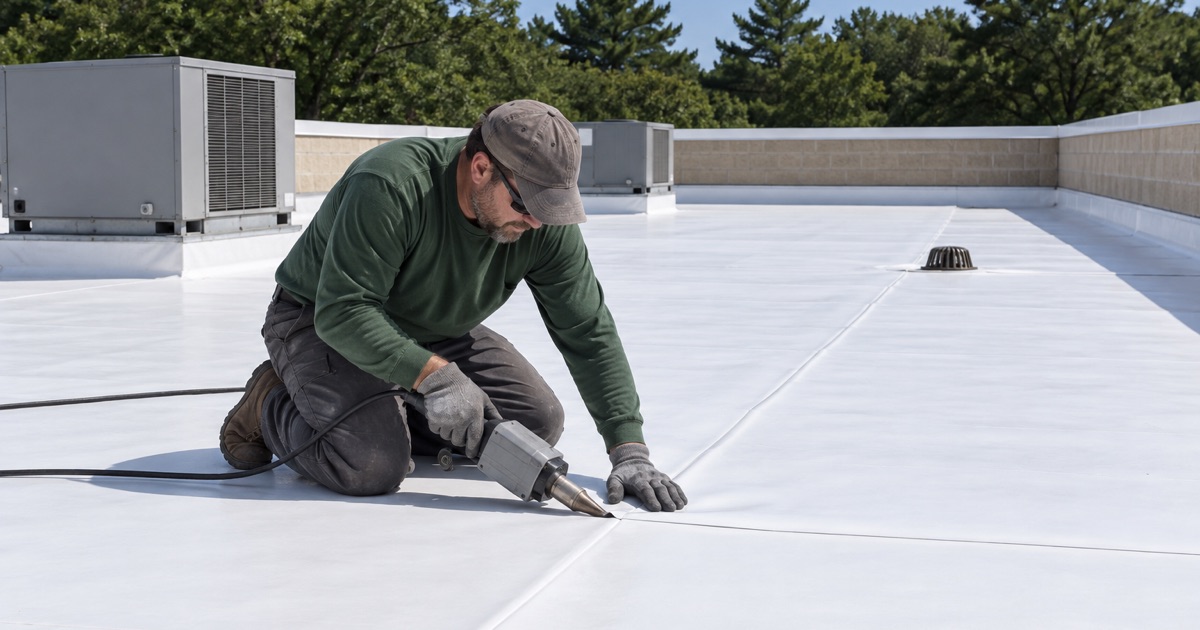
TPO and PVC are single-ply thermoplastic membranes with seams that are heat-welded into a continuous sheet. Their light-colored surfaces reflect sunlight, which can reduce cooling loads on buildings with large flat roofs. We install them mechanically fastened or fully adhered over new insulation, depending on the deck and the wind exposure of the building.
Welded seams are the strength of these systems, and every one is probed after welding to confirm it is continuous. Flashings at walls and curbs are made from the same membrane, so the whole roof is welded into a single watertight surface.
EPDM Rubber Roofing
EPDM is a synthetic rubber membrane that has been used on low-slope roofs for decades. It stays flexible in cold weather, handles building movement well, and comes in large sheets that reduce the number of seams. We install EPDM fully adhered or ballasted, with seam tape and flashings designed for rubber membranes.
Older EPDM roofs often leak at seams where the original adhesive has let go, or at flashings that have shrunk away from walls and curbs. Those are repairable with modern seam tape and new flashing, and a roof with a sound field of rubber can often be kept in service for years more before replacement.
Modified Bitumen Roofs
Modified bitumen roofs, including torch-down SBS and APP systems, are built in multiple plies with a granulated cap sheet on top. The thick, layered surface stands up well to foot traffic around rooftop units and to the occasional dropped tool. They are a good fit for smaller commercial roofs, mixed-use buildings and low-slope sections that see regular maintenance visits.
Drainage, Edges and Rooftop Equipment
Drains, Scuppers and Ponding Water
Standing water is the enemy of any flat roof. It finds every weak seam, adds weight to the structure and breaks down some membranes faster. We check drains, scuppers and gutters, clear blockages, and where water ponds we can add tapered insulation during a replacement so the roof slopes toward its drains.
Drain bowls and their clamping rings are a common leak point. On every repair or replacement we inspect the drain assembly itself, not just the membrane around it, and replace cracked or corroded parts.
Curbs, HVAC Units and Penetrations
Rooftop units, exhaust fans, vent stacks and conduits all pass through the roof, and each one needs flashing designed for it. We flash curbs with membrane carried up their sides and capped with metal, and we use prefabricated boots or pitch pans where they suit the penetration. We coordinate with your mechanical contractor when units must be lifted or reset.
Edge Metal, Copings and Walls
Wind attacks a flat roof at its edges first. Properly fastened edge metal, gravel stops and parapet copings hold the membrane down at the perimeter, where uplift forces are highest. Along parapet walls, we carry the membrane up the wall and terminate it under counter flashing or a reglet so water cannot run behind it.
Parapet caps deserve attention on older masonry buildings. Cracked mortar joints and loose coping stones let water into the wall from above, and it often shows up inside looking like a roof leak. We inspect the coping and the masonry along with the membrane so the repair goes where the water is actually entering.
Steep-Slope Commercial Buildings
Shingle and Metal Roofs on Commercial Properties
Not every commercial building has a flat roof. Offices converted from houses, small retail buildings, churches and many multifamily properties have steep-slope roofs in architectural shingles or standing seam metal. We install and repair these with the same flashing and ventilation standards we use on homes, scaled to the size of the building.
Multifamily and Association Roofs
Apartment buildings and condominium communities often have a mix of steep and low-slope roofs under one owner or association. We review the governing documents to confirm who is responsible for each roof before quoting, and we can phase replacements building by building so the work matches the association’s capital reserve plan.
Planning Commercial Roof Work
Inspections and Maintenance Plans
A yearly inspection catches the small failures that cause most commercial leaks: open seams, loose flashing, clogged drains and damage from rooftop equipment service. We document each finding with photos and locations so repairs can be priced and scheduled, and so owners have a record of the roof’s condition over time.
Working Around Your Business
We plan commercial projects around operating hours, deliveries and parking. Dumpsters and material staging are placed to keep entrances clear, and the roof is opened only as far as it can be closed the same day. Interior areas below the work are protected when needed, and the site is cleaned at the end of every day.
Safety and Insurance on Commercial Jobs
Commercial roofs carry real fall hazards at edges, skylights and roof openings. Our crews use fall protection, and we keep perimeter and skylight protection in place throughout the job. Owners should ask any roofing contractor for proof of workers’ compensation and liability insurance before work begins, and to check that the coverage is current for the dates of the job.
- 20+ Years on Monmouth County Roofs
- Line-Item Written Estimates
- Same-Day Storm Tarping